
There is actually no point in writing a large list of do’s and dont’s because Turkish people just want you to relax and have fun with them or have a pleasant stay in their houses. Nevertheless, here are some tips that you should bear in mind.
1. AN INVITATION TO THEIR HOUSE

‘Hoşgeldiniz’ carpet
Turkish people invite everyone anytime to their house. It might just be for having tea or turkish coffee, breakfast or a formal evening meal. Remember to answer ‘Hoş bulduk’ (happy to be here and being welcomed) when they tell you ‘hos geldiniz’ (welcome) while entering the house.

- Interesting fact #1: Shoes in the house are generally not allowed. Instead you will be given apair of slippers. In some houses, you will be handed in a wet wipe to clean your hands too. No shoes are allowed because the floor is usually wood and there are lots of carpets in the house.
2. TURKISH BODY LANGUAGE (Important)
-

Turkish gesture to say ‘NO’
Interesting fact #1: Raising your chin, moving your eyebrows up and simultaneously clicking your tongue means “NO” or “I don’t like it” (Try it. It is fun!). This is one of the most common gestures in Turkey.
- Interesting fact #2: Turkish people greet by kissing each other on both cheeks (but this is done actually touching the cheeks). This can be done man to man, woman to woman or man to woman. If you are very close to that person you canalways shaking hands. When you meet a friend, you generally kiss on both cheeks. In Turkey, it is common to hold the hand of a friend or walk with your arm over your friend’s shoulder. This does not mean they are homosexual, this is a sign of close friendship. Nevertheless, some very religious people avoid any contact with the opposite sex.
- Interesting fact #3: Never blow your nose loudly in public. It is considered a very bad manner.

Never play ‘got your nose’ in Turkey

- Interesting fact #4: Do you remember playing ‘got your nose’ with children? As an Englishteacher, I suggest avoiding this… This gesture (making a fist and put your thumb between your index finger and middle finger) means you are making a gesture called ‘a fig’, which means you are telling someone to f*** off.
-

Turkish respect hand kiss
Interesting fact #5: Don’t be surprised if you see children and men kissing the back of an elder’s hand and raising it to their forehead for a brief touch. It is the way to show respect.

- Interesting fact #6: When entering a room if you are not automatically met by someone greet the most elderly first. Use ‘selam’ to greet people. It is averyimportant word in Turkey.
3. GOING OUT IN TURKEY
- Interesting fact: In Europe, most guys usually go out with their male friends. In Turkey, a group of male friends can’t usually enter a pub without girls in their group. Even if there’s a group of 5-8 guys and only 1-2 girls the doorman will stop them and they can’t enter the club or disco. It has to be at least 50% guys-girls balance in the group. The reason? I will let your imagination free.
4: GIFT GIVING

Turkish famous desert ‘baklava’ (it’s delicious)
Bringing a gift to your host is one of the most applied turkish customs. There is even a phrase for this: “Coming empty-handed” which means ‘elin bos gidilmez’ in Turkish.If you don’t bring anything it is usually seen as rude. The most usual given gifts are: desert like ‘baklava’, box of chocolates, flowers, or anything for the house.
5. DAILY LIFE EXPENSES

Rakı
Basic needs like food, clothes and accommodation are usually cheaper in Turkey than in Europe. Tugce and I do the month shopping for 200 TL approximately (65 euros). And… we LOVE eating! Clothes are normally cheap too, especially in street markets and bazaars. They are often cheaper in shopping malls than in Europe. The only expensive stuff are alcohol, electronics and fuel. Alcohol taxes are very high in Turkey and so is fuel. Fuel is about 2€/liter, which means a lot for a Turkish average salary. One bottle of original Vodka is about 30€ and a cheap wine is about 4-5€. Even the traditional famous Turkish drink ‘Rakı’ is expensive.
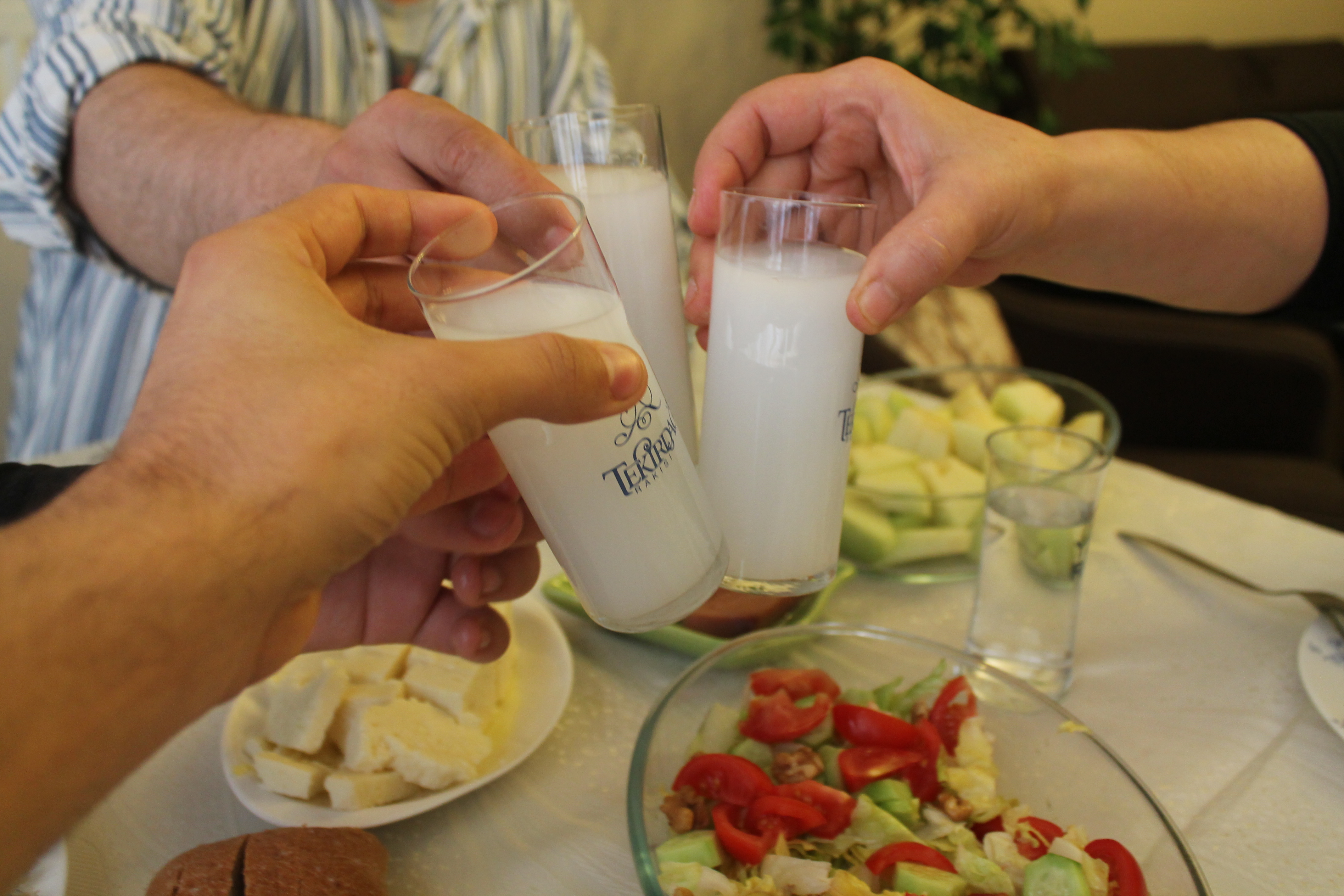
Turkish toasting with ‘Raki’


